Oct . 28, 2026 01:04 Back to list
Buy Temporary Fence Panels for Sale: Choosing by Opening Size, Wire Diameter and Application
THE BUYER'S GUIDE / SELECTION
Buy Temporary Fence Panels for Sale: Choosing by Opening Size, Wire Diameter and Application
When you buy temporary fence panels for sale, getting the specifications right matters as much as the price. This guide walks through the key selection criteria for the Australian Temporary Fence Panel — opening size, wire diameter, frame dimensions and surface treatment — and explains how each parameter affects performance across construction sites, public events and other short-term enclosure needs. Hebei Dunqiang Hardware Mesh Co., Ltd. supplies panels built to Australian Standard AS 4687-2007 with multiple configurable options, helping buyers match the right panel to their application before placing a wholesale order.

Opening size (50×50 mm, 50×150 mm, 60×150 mm, 100×200 mm): determines security level, object-passage resistance and wind loading — choose tighter openings for crowd management, child safety and high-security perimeters; wider openings reduce weight for event delineation.
Wire diameter (3.2 mm, 3.5 mm, 4 mm): governs panel rigidity, weight and impact resistance — lighter gauges suit short-duration events and frequent relocation; heavier gauges are specified for demolition, accident sites and high-contact environments.
Panel size (H × W): available in 1.8 × 2.2 m through 2.1 × 2.7 m — height determines deterrence level; wider panels reduce the number of joins and clips required along a perimeter.
Frame outer diameter (32 mm–48 mm) and wall thickness (1.5 mm–2.0 mm): larger sections increase stiffness and load capacity; lighter sections favour frequent-relocation and rental-fleet scenarios.
Surface treatment (hot-dip galvanized + painted silver, or black wire/pipe + hot-dip galvanized): selection depends on climate severity, coastal exposure and any requirement for secondary coating or specific appearance.
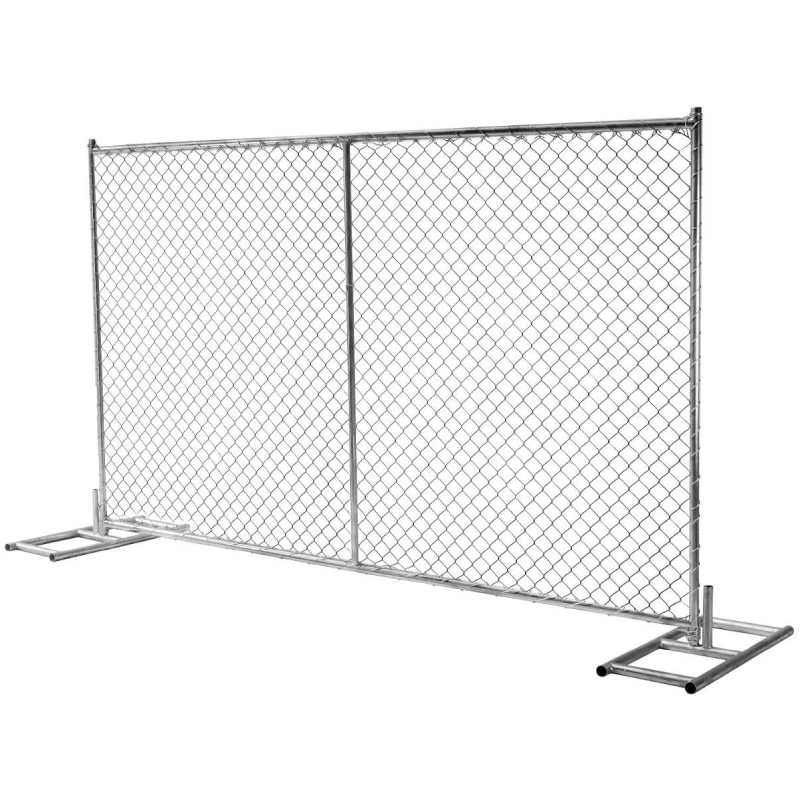
Plastic feet dimensions and connection hardware: three standard base sizes available; no ground penetration required, enabling use on paved or service-rich surfaces; square-top frame supports optional barbed wire bracket attachment.
Why Specification Matters When You Buy Temporary Fence Panels for Sale
Buyers sourcing temporary fencing wholesale often face a long list of panel variants. Size codes, wire gauges and mesh opening labels look similar on a spec sheet but translate into real differences in security, portability and service life on site. Before committing to a bulk order, understanding what each parameter does — and which combinations suit your application — reduces the risk of receiving panels that underperform or require early replacement.
The sections below focus on the Australian Temporary Fence Panel supplied by Hebei Dunqiang Hardware Mesh Co., Ltd., which is manufactured in accordance with Australian Standard AS 4687-2007 Temporary Fencing and Hoardings. All specifications are drawn from the confirmed product data; customisation may be available on request.
Selection Criterion 1: Opening Size
Mesh opening size determines how much of a barrier the panel actually provides and how visible the area behind the fence remains.
| Opening Size | Typical Use Case |
|---|---|
| 50 × 50 mm | High-security sites, crowd barriers, areas requiring minimal gap |
| 50 × 150 mm | Standard construction site perimeters |
| 60 × 150 mm | General site enclosure with moderate visibility |
| 100 × 200 mm | Lightweight event delineation where full containment is not critical |
Key considerations:
- Smaller openings (50 × 50 mm) resist object passage and are preferred where child safety or crowd management is a priority.
- Larger openings (100 × 200 mm) reduce panel weight and wind loading, which can be an advantage at outdoor events.
- For most Australian construction and demolition sites, 50 × 150 mm or 60 × 150 mm is the standard choice.
Selection Criterion 2: Wire Diameter
Wire diameter directly affects the panel's rigidity, weight and resistance to deformation under impact or lateral pressure.
Available wire diameters: 3.2 mm, 3.5 mm, 4 mm (or as requested).
How to choose:
- 3.2 mm wire is suitable for lighter-duty event fencing or short-duration projects where panel weight and handling speed are priorities.
- 3.5 mm wire represents the common balance between rigidity and portability for standard construction and civil projects.
- 4 mm wire provides the highest stiffness and impact resistance, recommended for accident sites, demolition perimeters or any location where the fence may face heavy contact.
Wire diameter interacts with opening size: a wider mesh opening with thinner wire saves weight; a tighter mesh with thicker wire maximises containment. Match both to the risk level at the site.
Selection Criterion 3: Panel Size (Height × Width)
The Australian Temporary Fence Panel is available in the following standard panel dimensions:
- 1.8 m × 2.2 m
- 1.8 m × 2.4 m
- 2.1 m × 2.4 m
- 2.1 m × 2.7 m
- Custom sizes on request
The 1.8 m height meets the minimum barrier height commonly required on many Australian and New Zealand sites; the 2.1 m height provides an additional deterrent against climbing and is frequently specified for higher-risk locations. Wider panels (2.4 m and 2.7 m) mean fewer panel joins along a perimeter, reducing clip count and installation time.
Selection Criterion 4: Frame Outer Diameter and Wall Thickness
The perimeter tube (frame) carries the structural load. Choosing the right outer diameter (OD) and wall thickness prevents sagging, bowing and premature joint failure.
Frame OD options: 32 mm, 38 mm, 40 mm, 42 mm, 48 mm Frame wall thickness options: 1.5 mm, 1.8 mm, 2.0 mm
- Larger OD and greater wall thickness increase panel stiffness and load capacity but also add weight per panel. For projects involving frequent relocation, a lighter combination (e.g. 32 mm OD / 1.5 mm wall) may be preferred.
- For sites with a fixed, long-term temporary perimeter — such as a multi-month construction project — a heavier section (48 mm OD / 2.0 mm wall) justifies its weight through greater durability.
Selection Criterion 5: Surface Treatment
Corrosion resistance is critical for panels used in harsh outdoor environments. Two surface treatment options are available:
- Hot-dip galvanized wire and pipe + painted silver colour — provides a durable zinc coating on both mesh and frame, with a paint finish that improves UV and weather resistance. This is the most common choice for Australian climates.
- Black wire/pipe + hot-dip galvanized — a zinc coating applied over a black-treated base; suited to buyers who require a specific visual appearance or who will apply a secondary coating.
The product description notes that the construction uses galvanized welded wire mesh and round tubes, delivering a smooth surface with excellent rust and corrosion resistance. This is particularly relevant for coastal or high-humidity environments.
Selection Criterion 6: Feet and Connection Hardware
A temporary fence panel stands only as well as its base supports it.
Plastic feet (base) sizes available:
- 560 × 240 × 130 mm
- 600 × 220 × 150 mm
- 610 × 230 × 150 mm
The self-supporting plastic feet allow the fence to stand without ground penetration, which is important on paved surfaces or where underground services must not be disturbed. Panels are connected using standard fence clips; the square-top frame design also allows barbed wire brackets to be attached when additional security is required.
Application Matching Guide
| Application | Recommended Opening | Wire Diameter | Panel Height |
|---|---|---|---|
| Construction / demolition site | 50 × 150 mm or 60 × 150 mm | 3.5 mm or 4 mm | 1.8 m or 2.1 m |
| Accident / emergency zone | 50 × 50 mm | 4 mm | 2.1 m |
| Public event / crowd control | 50 × 150 mm | 3.2 mm or 3.5 mm | 1.8 m |
| Infrastructure / civil works | 60 × 150 mm or 100 × 200 mm | 3.5 mm | 1.8 m or 2.1 m |
| Commercial / industrial site | 50 × 50 mm or 50 × 150 mm | 3.5 mm or 4 mm | 2.1 m |
Practical Buying Considerations
Reusability and Transport
The panels are described as reusable and easy to transport and store. For buyers purchasing temporary fence panels wholesale for a rental fleet or multi-site deployment, panel weight per unit (governed by wire diameter, frame size and panel dimensions) is a key cost driver for logistics.
Customisation
Custom panel sizes, wire diameters and opening sizes are available on request. Branding or sign tagging on panels is also offered for event organizers or site managers who need identified perimeter barriers. Logo printing on products and packaging is available when minimum order quantity (MOQ) requirements are met.
Quality Assurance Process
Hebei Dunqiang Hardware Mesh Co., Ltd. applies strict detection during production and sampling inspection before shipment, with intact packaging ensured for delivery.
About Hebei Dunqiang Hardware Mesh Co., Ltd.
Hebei Dunqiang Hardware Mesh Co., Ltd. was established in 2006 and is located in Anping, Hebei Province — a recognised wire mesh production hub in China. The company supplies fencing products to markets in Europe, America, Asia, the Middle East and Africa, with a focus on consistent quality and customer-oriented service.
Summary: How to Select the Right Temporary Fence Panel
When you need to buy temporary fence panels for sale — whether for a single project or a wholesale order — the decision comes down to five matched parameters:
- Opening size aligned to your security and visibility requirements.
- Wire diameter matched to site impact risk and handling frequency.
- Panel dimensions chosen to minimise joins and suit required barrier height.
- Frame OD and wall thickness balanced against weight and durability needs.
- Surface treatment appropriate for local climate and service duration.
Starting from the confirmed specifications of the Australian Temporary Fence Panel and mapping each option to your site conditions produces a specification that is fit for purpose rather than simply the cheapest available. Contact Hebei Dunqiang Hardware Mesh Co., Ltd. to discuss your project requirements and available options.
THE PEOPLE

About the author
THE COMPANY
Hebei Dunqiang Hardware Mesh Co., Ltd.
Hebei Dunqiang Hardware Mesh Co Ltd is established in 2006, It is located in China Wire Mesh Home Town -Anping, Hebei Province. Our products are widely sold across China and meanwhile expanded to countries and districts in Europe, America, Asia, Mid-East, Africa and so on. Our company and our products get a good applause by customers both domestic and abroad. Our company focuses on customer need and is orientated by advanced technique process and technology development.…
About Us ↗Visit company website ↗YOUR NEXT STEP
Bring your brief. Start a useful conversation.
Use case, specification, quantity and delivery window: make the next conversation specific.
-
Temporary Fence Panels Canada: Answers on Size, Finish, and Ordering
NewsNov.03,2026
-
358 Anti Climb Fence FAQ: Dimensions, Coatings and Ordering Questions
NewsOct.29,2026
-
Choosing Cattle Fence: Rail Height, Post and Rail Size, Coating and Application
NewsOct.23,2026
-
Cattle Fence Cost Analysis: Total Ownership Expenses
NewsOct.22,2026
-
Durable Temporary Picket Fence for Versatile Containment Solutions
NewsJul.01,2026