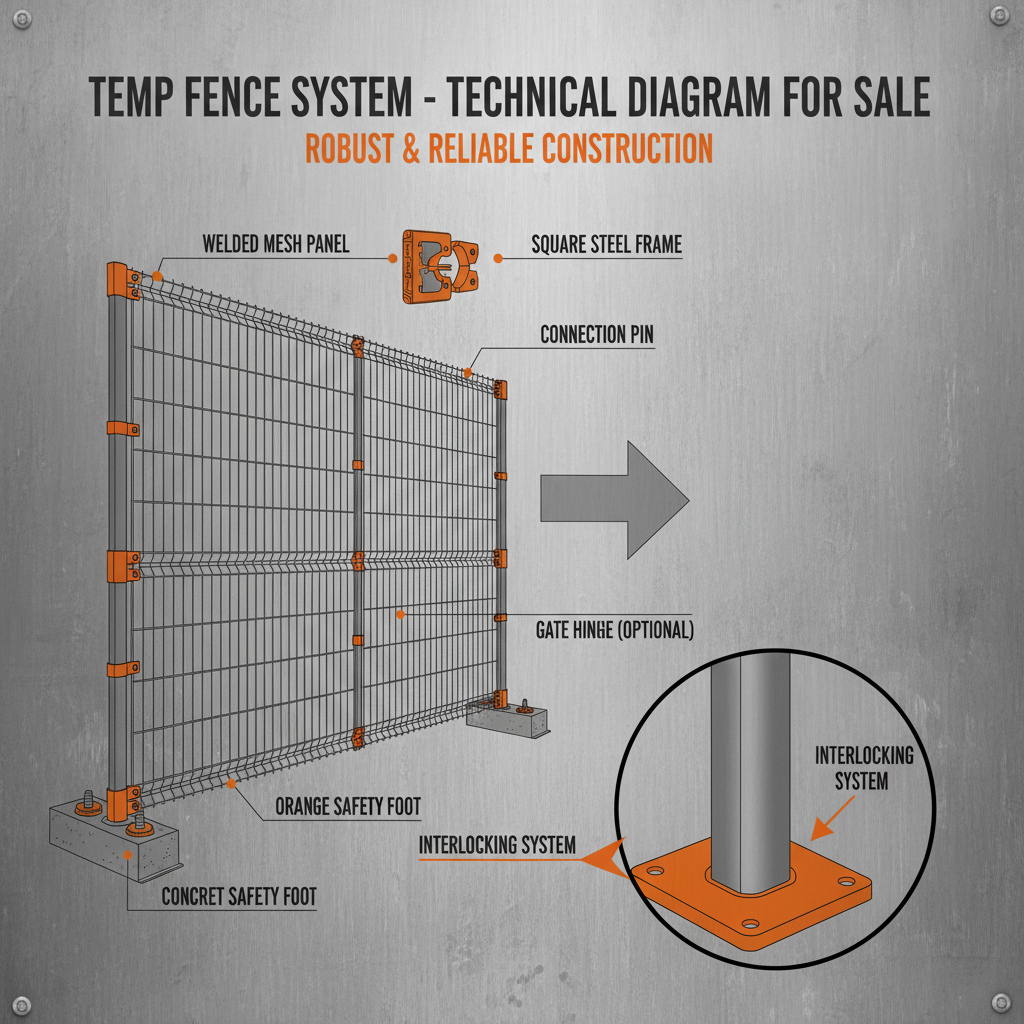
Securing a construction site is not merely about placing a physical barrier; it is about managing risk, liability, and pedestrian safety in dynamic urban environments. As projects scale in complexity, the reliance on modular, rapid-deployment systems has shifted from a convenience to a regulatory necessity.
The challenge for project managers often lies in balancing the need for high security with the requirement for portability. Traditional fixed fencing is too permanent for phase-based construction, while flimsy barriers fail to prevent unauthorized access or withstand wind loads.
Choosing a professional temporary construction fence company requires an understanding of material specifications and deployment logic to ensure the site remains compliant and secure throughout its lifecycle.


Historically, construction site boundaries were marked by simple wooden hoardings or chain-link rolls that required extensive digging and permanent posts. However, the rise of "just-in-time" construction and urban infill projects demanded a more agile solution.
The industry moved toward freestanding, modular steel systems. These designs eliminate the need for concrete footings, allowing the perimeter to shift as the project expands or contracts. This transition has significantly reduced labor costs and site restoration time.
A high-performance temporary barrier is defined by its joining system and structural stability. Modern systems typically utilize a "Hook and Sleeve" mechanism, which allows panels to be locked together without tools. This ensures a continuous line of defense that resists gaps, which is critical for preventing unauthorized pedestrian entry.
The frame geometry is equally vital. Utilizing outer tubes ranging from 32mm to 42mm O.D. provides a balance between weight and rigidity. For instance, an outer tube of 42mm with a wall thickness of 2.0mm offers significantly higher resistance to impact than lighter alternatives, making it suitable for high-traffic urban zones.
Support systems have evolved from simple flat feet to crossed and bridge-style feet. These variations allow the barrier to be deployed on uneven terrain or concrete slabs without the need for sandbags or digging, maintaining the "freestanding" advantage that defines the efficiency of a professional temporary construction fence company.
Temporary does not mean disposable. Because these fences are repurposed across multiple project sites, the surface treatment determines the total cost of ownership. The primary enemy of steel fencing is oxidation, especially in coastal or humid environments.
The transition from simple galvanization to hot-dipped galvanized steel, and subsequently to PVC coating, represents a shift toward lifecycle value. Hot-dipped coatings provide a metallurgical bond that prevents rust from spreading, while PVC adding an extra layer of chemical and weather resistance.
Companies like Hebei Dunqiang Hardware Mesh Co Ltd implement ISO 9001 standards to ensure that every weld and coating layer meets precise thickness specifications. This rigor prevents premature failure in the field, ensuring that the fence remains a viable asset for years rather than a single-use expense.
Selecting the right barrier requires a quantitative approach to site needs. Factors such as expected crowd pressure, wind exposure, and the required height of the enclosure dictate the technical specifications of the panel.
For example, a concert crowd control barrier requires higher lateral stability than a simple construction perimeter fence. Evaluation often involves analyzing the "Value Index" across different parameters: installation speed, durability, stability, versatility, and cost-efficiency.
The practical utility of these systems is best seen in their diverse application. In pedestrian control for sporting events or parades, the emphasis is on lightweight portability and rapid repositioning. In contrast, for a construction site, the priority is absolute boundary definition and the prevention of accidental trespass.
Logistics also play a critical role in procurement. Efficient packing—where panels are wrapped in plastic bands and secured on pallets—ensures that the product arrives without transit damage. For large-scale projects, the ability of a supplier to customize panel sizes (such as 1.1x2.1m or 1.2x2.5m) ensures that the perimeter fits the site's exact dimensions without wasteful overlapping.
The industry is currently seeing a shift toward "intelligent" perimeter management. While the physical barrier remains steel, the integration of temporary sensors and camera mounts directly onto the fence posts is becoming common. This allows a temporary fence to serve as a security hub.
There is also a growing demand for aesthetically neutral options. In high-end urban developments, the "industrial look" of galvanized steel is often replaced by dark green, black, or brown PVC coatings to blend with the surrounding landscape, reducing the visual impact of the construction phase.
Furthermore, sustainability is driving the move toward fully recyclable steel alloys. The focus is no longer just on how long the fence lasts, but how efficiently it can be reclaimed and re-smelted at the end of its long-term operational life.
For procurement officers, the decision between different temporary fencing options involves a trade-off between initial cost and operational durability. A cheaper, thin-walled panel may save budget today but will warp under pressure or rust within one season.
A professional evaluation should consider the tube diameter (O.D.) and the frame thickness. A 2.0mm thickness is generally the benchmark for "heavy-duty" applications, whereas 1.2mm is sufficient for low-risk pedestrian guidance.
The following framework illustrates how to match specific project requirements with the appropriate technical specifications to maximize site safety and ROI.
| Application Scenario | Recommended Tube O.D. | Frame Thickness | Surface Treatment |
|---|---|---|---|
| Public Parades / Fairs | 32mm - 35mm | 1.2mm - 1.5mm | Galvanized |
| Urban Construction Site | 38mm - 40mm | 1.5mm - 1.8mm | Hot-Dipped Galv. |
| High-Security Perimeter | 42mm | 2.0mm | PVC Coated |
| Sporting Event Crowd | 35mm - 38mm | 1.5mm | Galvanized |
| Coastal Infrastructure | 40mm+ | 1.8mm+ | PVC Coated |
| Temporary Event Parking | 32mm | 1.2mm | Galvanized |
A freestanding fence is designed with integrated support feet—such as flat, bridge, or crossed feet—that allow the panels to stand upright without being anchored into the ground. This eliminates the need for digging post holes or using heavy sandbags, making the system highly portable and easy to reposition as the site needs change.
Hot-dipped galvanization creates a thick zinc layer that bonds chemically with the steel, providing excellent rust protection. PVC coating is applied over the galvanized layer, adding an extra barrier against chemicals and saltwater while allowing for different colors (black, green, white) to improve the aesthetic appeal of the site.
While customization is available, sizes like 1.1x2.1m or 1.1x2.2m are industry standards. They provide a sufficient height to deter trespassers while remaining light enough for two workers to install quickly. The choice depends on the specific risk profile and the amount of wind load the area is subject to.
These are specifically engineered for temporary use. While their durability is high, they lack the deep foundation and permanent anchoring required for long-term security boundaries. For permanent needs, welded fences with concrete posts are the appropriate choice, though temporary systems can serve as a stop-gap during the installation phase.
The hook and sleeve system allows panels to be connected almost instantaneously without the need for bolts, nuts, or specialized tools. This not only speeds up the deployment process but also ensures that the fence line remains tight and secure, preventing gaps that could be exploited by unauthorized persons.
Look for adherence to international standards like ISO 9001. Verify the actual wall thickness of the tubes (not just the outer diameter) and the type of surface treatment used. A reputable supplier will provide clear specifications on frame thickness (e.g., 1.2mm to 2.0mm) and offer customized options based on the specific environmental conditions of your project.
Effective site security is a balance of material science and operational logistics. By moving away from static boundaries and embracing modular steel systems, construction firms can significantly enhance their safety protocols while reducing the labor burden of site setup and teardown.
The long-term value of a perimeter system is found in the details—the gauge of the steel, the quality of the galvanization, and the reliability of the joining mechanism. Investing in professional-grade equipment ensures that the site remains secure, compliant, and professional throughout the duration of the project.